

2008/12/22
Considering the CHIMP ...
My son wants a CHIMP for Christmas.
Not a chimpanzee. A CHIMP. Basically, a rear-view mirror for the geek set. CHIMP is a recursive acronym, meaning CHIMP Has Invincible Monkey Powers.
I don't have a CHIMP.

I have a baby mirror, and I have a webcam. Both serve the same purpose, which is giving me a visual indicator of motion behind me, so I don't have to be surprised and scared when someone comes up to me.
The pic of my desktop (and no, my walls are not nearly that yellow) comes from my camera phone, which appears in both the mirror and the webcam.
2008/12/21

2008/12/19
Pondering Amazon's Suggestions...
I have many machines whose speed I'm relatively happy with but whose storage limits are much too small. In 2008, 40GB is just too small. It might be obvious, but the machines I'm talking about have EIDE. They're just not new enough for SATA.
There's nothing wrong with SATA. In fact, I'd say that the skinny connectors of SATA are far better than the fragile pins and wide ribbons of EIDE. But, I have no SATA at home. Nothing's new enough.
So, I'm stuck on the horns of a dilemma. I want as massive a jump in drive space as I can, but I don't want to be stuck in the past. They stopped making EIDE a year ago. So, what do I do?
There's a 500GB EIDE drive on Amazon at near the price point I'm hoping for. 500GB isn't a terabyte, but it certainly isn't 40GB.
But what gets me is the suggestion box. If you're buying a Stephen King book and they suggest that you might want to get The Stand, too. That makes sense. When you're buying a Punch Brothers CD and they suggest that you might want to get Nickel Creek, too, that's logical. When you're looking at a 500GB EIDE hard drive and they suggest that you might want a 500GB SATA drive, too, that makes no sense.
While I was on Amazon, I thought I might look for a few more things. I work in a dank sub-basement and have no phone on my desk, so I thought getting a Skype phone might be useful. I saw The GE 2-in-1 phone, first at Wal-Mart and then on Amazon. I've seen them before. I'm thinking that a portable phone that talks Bluetooth and Wifi is nothing but win, especially if I can afford to Skype out eventually. But there's a big massive downside. Phone talks to PC, PC talks to Skype. And that means Phone talks to Microsoft-Operating-System-bearing PC, PC talks to Skype. I've used enough Unix and Linux and enough Windows to know that I want to use more Unix, so I want to use less and less to no Windows. Later versions are pure Skype phones, with no connection to a PC. Later versions are $100+. I still think it's a good idea.
GE is also starting to make home phones which call out and pick up on your cell phone, connecting via Bluetooth. On one hand, it makes a bit of sense. When I was an undergrad the second time, about 10 years ago, I was beginning to see and hear about people who were turning off local phone service and only using their cell phone. This makes a reasonable amount of sense to me. In my household, we have cellphones and Vonage and we're considering switching to a cheaper Asterisk solution. So, doing away with the local phone makes sense. But I don't know the benefit of having the phone you use at home not be the phone you use when you're away. The vision I have is of exploding the parts of the phone, not replicating the unified phone of the past. You can get Bluetooth headsets that allow you to talk while using your hands. You can get Bluetooth watches that flash the CallerID information when you get a call. Your phone is in your pocket. What's the point of having a separate home phone that isn't really a separate home phone?
Speaking of, I'm drawn to a Bluetooth dongle I've seen at Wal-Mart for $20. I have a Bluetooth earpiece and a phone that can talk to it, and maybe more and maybe not. So, I don't know what I'd get with that. But hopefully, it'll be cool.
In other news, my friend Patrick has beaten the final boss on OpenSolaris-vs-Windows-Server-2003. Joe User has penetrated the walls of Solaris via su, console, GTK and SSH. And I'm burning the game onto a CD-RW I had floating around. The drive in my #1 Linux box is a bit flakey, so I'm burning on my Windows box, a laptop with a broken screen. I've not been able to burn ISOs in Windows, but this evening I found
cdburn, which comes from Microsoft's Windows Server 2003 Resource Kit. It's a command-line tool, which the Unix guy in me loves. And now, or soon, I'll be able to burn ISOs from the common Windows machine at work.

2008/12/18
Going Through The Inbox ...
Hopefully, this isn't a boring thing. But it does have to be done.
This being the process of going through the magazines on my desk, putting the information onto the blog, and, the process, into my head.
Dr. Dobb's Journal, January 2009.
Just noticed something interesting. The Blogspot web interface traps Control-S and does a save of the current post text to the server, not the current page to the desktop. Pretty neat.
This being the process of going through the magazines on my desk, putting the information onto the blog, and, the process, into my head.
Dr. Dobb's Journal, January 2009.
- Functional Programming: Has It's Ship Come In?
Functional programming: It's hot, it's cool, it maybe maps to multi-core better than Procedural and Object-Oriented programming, but it isn't good with IO so it hasn't been big like some other languages. It's interesting. When I hear procedural, I think cop shows. When I hear functional, I think "it works". A procedural language follows a procedure. A functional language works via functions. This is the stereotype:function( function( function( function( function( function( function( function( function( function( function( function( ) ) ) ) ) ) ) ) ) ) ) )If it fails to work, just throw a few more close-parens.
The interesting thing about this article is that it suggests a few
- Mono, Linux and .NET Development
It's less that the thought of Microsoft stuff on Linux is repugnant to me than it seems like an odd sort of virtualization.
Just noticed something interesting. The Blogspot web interface traps Control-S and does a save of the current post text to the server, not the current page to the desktop. Pretty neat.
2008/12/16
Organizing My Thoughts on Catalyst
I am about three hours from presenting on Catalyst for my Perl Mongers meeting.
For those who don't know, Catalyst is a Web Framework using the MVC (Model-View-Controller) format to make for easier web development.
 Imagine the operators that you see sometimes in 1930s movies, or in old reruns of Laugh-In. The Model is the trunk line with people with information trying to connect in. The View is the person in Suite 14 receiving the calls.
The Controller, Catalyst and the code you write for it, is Lily Tomlin.
Up in Suite 14, running the View, is Template::Toolkit. I've never had reason for templating before, but I'm learning to like it. It's a powerful tool. The institutional view here in the subbasement is that you should limit the amount of logic you put in the View, doing all that mess in the Controller.
The Model is DBIx::Class, and the more I deal with it, the more I accept it as a powerful tool. I have been saying that Catalyst has made it hard for me to leverage the awesome power of SQL, but today I have been beating my head against the switchboard and whipping myself with patch cables, trying to do two simple things. If I get those two things done, I can use one View, one Template Toolkit file, with Catalyst
First, we have
Next, each person does something, and there's a table showing each time that person did that thing. We want to count each thing and establish
I can do that. I can use DBIx to get all that information. What I cannot do is put the genie back in the bottle. Or, I cannot patch it back into the View.
Which means, LOL fashion, that I'm doin' it wrong.
So, I'm off to read up on DBIx::Class, and there's next to zero chance that I'll be able to get this work before Perl Mongers.
For those who don't know, Catalyst is a Web Framework using the MVC (Model-View-Controller) format to make for easier web development.
 Imagine the operators that you see sometimes in 1930s movies, or in old reruns of Laugh-In. The Model is the trunk line with people with information trying to connect in. The View is the person in Suite 14 receiving the calls.
The Controller, Catalyst and the code you write for it, is Lily Tomlin.
Up in Suite 14, running the View, is Template::Toolkit. I've never had reason for templating before, but I'm learning to like it. It's a powerful tool. The institutional view here in the subbasement is that you should limit the amount of logic you put in the View, doing all that mess in the Controller.
The Model is DBIx::Class, and the more I deal with it, the more I accept it as a powerful tool. I have been saying that Catalyst has made it hard for me to leverage the awesome power of SQL, but today I have been beating my head against the switchboard and whipping myself with patch cables, trying to do two simple things. If I get those two things done, I can use one View, one Template Toolkit file, with Catalyst
First, we have
lastname and firstname, but we want name = firstname . ' ' . lastname . Unless there is no firstname, in which case name = lastname.Next, each person does something, and there's a table showing each time that person did that thing. We want to count each thing and establish
count.I can do that. I can use DBIx to get all that information. What I cannot do is put the genie back in the bottle. Or, I cannot patch it back into the View.
Which means, LOL fashion, that I'm doin' it wrong.
So, I'm off to read up on DBIx::Class, and there's next to zero chance that I'll be able to get this work before Perl Mongers.

2008/12/11
Taking control of my environment ...
As mentioned, I now have OpenSolaris available at my beck and call via VirtualBox.
Interesting story: Right about the time I finished that installation, I had problems with my screen setup. You see, I was bored, so I was playing with screen resolutions. My #1 monitor wants to be at 1680x1050, and due to my futzing, Gnome wouldn't let me get to anything closer than 1280x1024. Which looked like crap and kept the panels out of view.
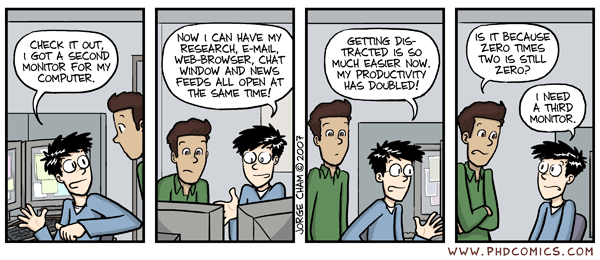
By the way, I love multiple monitors.

Anyway, you can right-click on the desktop and set your screen resolution under Windows. You can right-click on the desktop and set your screen resolution via Gnome under OpenSolaris. It is a menu option for Ubuntu. You cannot get to it via right-click, and sometimes you really need to.
That is, without modification.
Make a
Probably the easiest program I ever wrote! And with Intrepid, I didn't have to HUP Nautilus to make it see the scripts, which is always useful.
Interesting story: Right about the time I finished that installation, I had problems with my screen setup. You see, I was bored, so I was playing with screen resolutions. My #1 monitor wants to be at 1680x1050, and due to my futzing, Gnome wouldn't let me get to anything closer than 1280x1024. Which looked like crap and kept the panels out of view.
By the way, I love multiple monitors.
Anyway, you can right-click on the desktop and set your screen resolution under Windows. You can right-click on the desktop and set your screen resolution via Gnome under OpenSolaris. It is a menu option for Ubuntu. You cannot get to it via right-click, and sometimes you really need to.
That is, without modification.
Make a
~/.gnome2/nautilus-scripts/ directory. Make a file called Screen Resolution. Make it executable. And make it say this:
#!/bin/bash
/usr/bin/gnome-display-properties
Probably the easiest program I ever wrote! And with Intrepid, I didn't have to HUP Nautilus to make it see the scripts, which is always useful.
2008/12/09
Getting it going ....
When i worked at the other place, we used Synergy. Not the bad and byzantine source-control Synergy, but the software KVM tool.
I have a laptop that's unusable as a laptop, so it is my Windows machine. The screen is busted, so I have it connected to a big screen, and the keyboard is busted, so it's not all that much fun to use. So, I tried the power of Synergy, like I had been using at work.
And I failed.
Talking to Patrick, I figured out the issue. Synergy wants to talk names, not raw IP addresses. I had no local DNS. What few machines needed to talk to each other, I have their 192.168 addresses memorized. But Synergy wanted to work with names.
The solution?
Or
(There's no legacy BSD code involved with XP. Nope.)
So, I made the wired NIC on the laptop static, named it, and set up Synergy again. And I'm writing on my XP machine via the keyboard on one of my Ubuntu machines' keyboard.
Honestly, I have that keyboard hooked to a KVM switch going between two Ubuntu machines, but that's another story.
I have a laptop that's unusable as a laptop, so it is my Windows machine. The screen is busted, so I have it connected to a big screen, and the keyboard is busted, so it's not all that much fun to use. So, I tried the power of Synergy, like I had been using at work.
And I failed.
Talking to Patrick, I figured out the issue. Synergy wants to talk names, not raw IP addresses. I had no local DNS. What few machines needed to talk to each other, I have their 192.168 addresses memorized. But Synergy wanted to work with names.
The solution?
/etc/hosts Or
c:\Windows\system32\drivers\etc\hosts(There's no legacy BSD code involved with XP. Nope.)
So, I made the wired NIC on the laptop static, named it, and set up Synergy again. And I'm writing on my XP machine via the keyboard on one of my Ubuntu machines' keyboard.
Honestly, I have that keyboard hooked to a KVM switch going between two Ubuntu machines, but that's another story.
Subscribe to:
Posts (Atom)